

In today’s digital-first world, cyber threats are becoming more sophisticated, frequent, and costly than ever before. Organizations of all sizes face a growing number of security challenges, including ransomware attacks, phishing campaigns, data breaches, insider threats, and advanced persistent threats. As businesses continue to adopt cloud technologies, remote work environments, and connected devices, the need for robust cybersecurity has become a critical priority. This is where managed cyber security services play a vital role.
Managed cyber security services provide organizations with access to professional cybersecurity expertise, advanced monitoring tools, and continuous protection without the need to build an extensive in-house security team. These services help businesses identify threats, respond to incidents, protect sensitive information, and maintain compliance with industry regulations. In 2026, managed security solutions have become a preferred choice for companies seeking reliable, scalable, and cost-effective protection against cyber risks.
What Are Managed Cyber Security Services?
Managed cyber security services refer to outsourced cybersecurity solutions delivered by specialized security providers. These providers monitor, manage, and protect an organization’s IT infrastructure, networks, applications, and data against various cyber threats. Instead of relying solely on internal teams, businesses partner with cybersecurity experts who offer around-the-clock monitoring and support.
The primary objective of managed cyber security services is to proactively identify vulnerabilities, detect suspicious activities, and respond to incidents before they can cause significant damage. These services often include security monitoring, threat detection, vulnerability assessments, endpoint protection, firewall management, security information and event management (SIEM), compliance support, and incident response.
Organizations benefit from a dedicated team of cybersecurity professionals who continuously analyze security events and ensure that systems remain protected against evolving threats. This approach allows businesses to focus on their core operations while leaving cybersecurity management to experienced specialists.
Why Businesses Need Managed Cyber Security Services in 2026
The cybersecurity landscape in 2026 is far more complex than it was just a few years ago. Cybercriminals now use artificial intelligence, automation, and advanced attack techniques to target organizations across various industries. Small businesses, medium-sized enterprises, and large corporations alike are vulnerable to attacks that can result in financial losses, reputational damage, and regulatory penalties.
Managed cyber security services provide businesses with a proactive defense strategy. Rather than reacting to incidents after they occur, organizations can identify and mitigate threats before they escalate. Continuous monitoring ensures that suspicious activities are detected immediately, reducing the likelihood of successful attacks.
Additionally, businesses face increasing regulatory requirements related to data privacy and cybersecurity. Compliance standards such as GDPR, HIPAA, PCI DSS, and industry-specific regulations require organizations to implement adequate security controls. Managed security providers help companies meet these requirements while maintaining strong security practices.
As remote work continues to grow and cloud adoption expands, the attack surface for organizations becomes larger. Managed security services help secure distributed environments, ensuring that employees, devices, and applications remain protected regardless of location.
Key Components of Managed Cyber Security Services
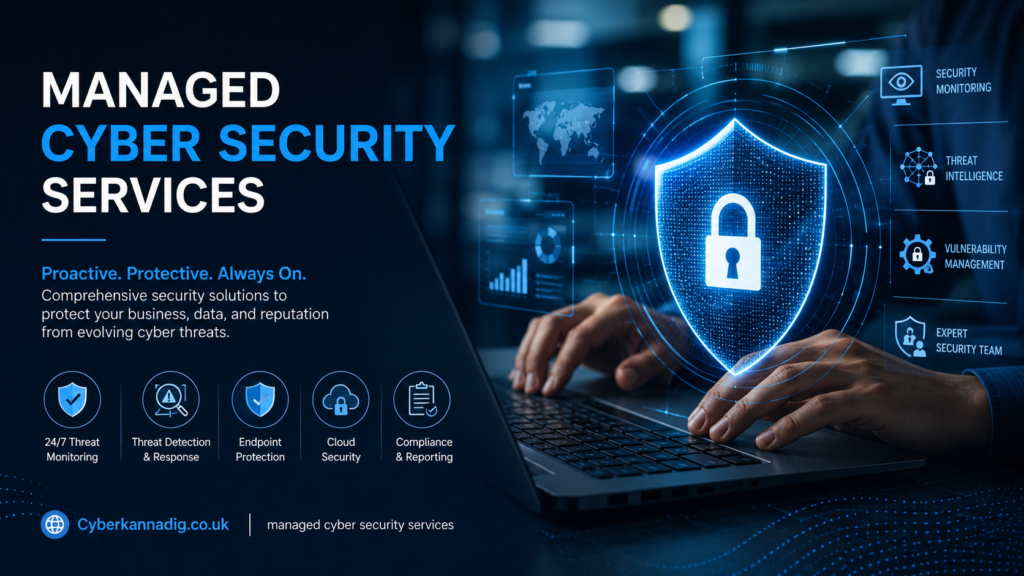
Managed cyber security services typically consist of several essential components designed to provide comprehensive protection. Security monitoring is one of the most important elements, allowing providers to observe network activity continuously and identify unusual behavior that may indicate a threat.
Threat detection and analysis involve using advanced technologies such as SIEM platforms, machine learning algorithms, and threat intelligence feeds to identify malicious activities. Security experts analyze alerts and determine the severity of potential threats before initiating an appropriate response.
Endpoint protection is another critical component. With employees using laptops, smartphones, tablets, and remote devices, endpoint security ensures that every device connected to the network remains protected from malware and unauthorized access.
Vulnerability management helps organizations identify weaknesses within their systems before attackers can exploit them. Regular assessments and patch management ensure that software vulnerabilities are addressed promptly.
Incident response services provide immediate support during security events. When a breach or attack occurs, cybersecurity professionals investigate the incident, contain the threat, and implement recovery measures to minimize damage.
Benefits of Managed Cyber Security Services
One of the most significant advantages of managed cyber security services is access to specialized expertise. Cybersecurity professionals possess extensive knowledge of emerging threats, attack techniques, and defense strategies. Many businesses struggle to recruit and retain qualified security personnel due to the global cybersecurity talent shortage. Managed services bridge this gap by providing access to experienced experts without the costs associated with building an internal team.
Cost efficiency is another major benefit. Hiring, training, and maintaining a full cybersecurity department can be expensive. Managed security providers offer enterprise-level protection at a predictable monthly cost, making advanced security accessible to businesses of all sizes.
Continuous monitoring and support ensure that threats are detected and addressed at any time of day. Since cyberattacks can occur outside regular business hours, having a 24/7 security operations capability significantly reduces response times and potential damage.
Scalability also makes managed security services attractive. As organizations grow, their security requirements evolve. Managed providers can quickly adapt their services to accommodate new users, devices, applications, and business locations.
Furthermore, managed security services help organizations improve compliance, reduce risks, and strengthen overall security posture through ongoing assessments and strategic guidance.
Common Threats Addressed by Managed Cyber Security Services
Cybersecurity providers protect businesses against a wide range of threats that continue to evolve in complexity and scale. Ransomware remains one of the most damaging cyber threats. Attackers encrypt critical data and demand payment in exchange for restoration. Managed security providers implement preventive measures, monitor for suspicious activity, and respond quickly to contain ransomware incidents.
Phishing attacks continue to target employees through deceptive emails, messages, and websites. These attacks often aim to steal credentials or deliver malware. Managed security solutions include email protection, employee awareness training, and advanced threat detection technologies to combat phishing attempts.
Malware infections, including viruses, spyware, trojans, and worms, pose significant risks to organizational systems. Managed security providers use endpoint detection and response tools to identify and remove malicious software before it spreads.
Insider threats can originate from employees, contractors, or partners who intentionally or accidentally compromise security. Monitoring user activity and implementing access controls help reduce these risks.
Distributed denial-of-service attacks, cloud security threats, credential theft, and supply chain attacks are additional concerns that managed cyber security services are designed to address effectively.
How Managed Security Operations Centers Protect Organizations
A Security Operations Center, commonly known as a SOC, serves as the backbone of many managed cyber security services. A SOC is a centralized facility where cybersecurity analysts monitor and manage security events across an organization’s environment.
Modern SOC teams operate around the clock, using advanced technologies to collect and analyze security data from multiple sources. This includes firewalls, endpoints, servers, cloud platforms, applications, and network devices. By correlating information from these systems, analysts can identify suspicious activities that may indicate a cyberattack.
Threat intelligence plays a significant role within a SOC. Analysts continuously monitor global cybersecurity developments and emerging threats, allowing them to proactively defend against new attack techniques. Automated tools help prioritize alerts, while human expertise ensures accurate analysis and response.
The SOC also coordinates incident response activities when security events occur. Analysts investigate alerts, determine their impact, and implement containment measures. This rapid response capability significantly reduces the risk of extensive damage and operational disruption.
In 2026, advanced SOCs increasingly leverage artificial intelligence and machine learning technologies to improve threat detection accuracy and operational efficiency.
Choosing the Right Managed Cyber Security Service Provider
Selecting the right managed cyber security services provider requires careful evaluation of several factors. Organizations should begin by assessing their specific security needs, industry requirements, and risk profile. Different providers offer varying levels of service, expertise, and specialization.
Experience and reputation are important considerations. Businesses should look for providers with a proven track record of protecting organizations within their industry. Client testimonials, case studies, certifications, and industry recognition can provide valuable insights into a provider’s capabilities.
The range of services offered should align with the organization’s security objectives. Providers should offer comprehensive solutions including monitoring, threat detection, incident response, compliance support, and vulnerability management.
Response times and service-level agreements are critical. Organizations should understand how quickly the provider responds to security incidents and what level of support is available during emergencies.
Technology capabilities should also be evaluated. Leading providers utilize advanced security tools, threat intelligence platforms, automation technologies, and skilled analysts to deliver effective protection.
Transparency, communication, and reporting are equally important. Businesses should receive regular security reports and have clear visibility into their overall security posture.
The Role of Artificial Intelligence in Managed Cyber Security Services
Artificial intelligence has transformed cybersecurity operations by enabling faster and more accurate threat detection. In managed cyber security services, AI-powered systems analyze massive amounts of security data in real time, identifying patterns and anomalies that may indicate malicious activity.
Machine learning algorithms continuously improve their detection capabilities by learning from historical data and emerging threat trends. This allows security teams to identify previously unknown attack methods and reduce false-positive alerts.
Automation enhances operational efficiency by handling routine tasks such as log analysis, alert prioritization, and threat correlation. Security analysts can then focus on investigating complex threats and making strategic decisions.
AI-driven threat intelligence platforms provide valuable insights into evolving cyber risks, helping organizations stay ahead of attackers. Predictive analytics also enable proactive risk management by identifying vulnerabilities and potential attack paths before they are exploited.
While AI significantly improves cybersecurity capabilities, human expertise remains essential. Managed security providers combine advanced technologies with experienced professionals to ensure accurate threat assessment and effective response strategies.
Future Trends in Managed Cyber Security Services
The future of managed cyber security services will be shaped by rapid technological advancements and evolving threat landscapes. Cloud security will continue to be a major focus as organizations increasingly migrate applications and data to cloud environments. Managed providers will offer more sophisticated cloud monitoring and protection solutions.
Zero Trust security models will gain wider adoption. Rather than assuming trust within a network, Zero Trust requires continuous verification of users, devices, and applications before granting access to resources.
Extended Detection and Response (XDR) platforms will become increasingly common, providing integrated visibility across endpoints, networks, cloud environments, and applications. This unified approach enhances threat detection and response capabilities.
Cybersecurity automation will expand, allowing organizations to respond to incidents more quickly and efficiently. Automated remediation processes will reduce response times and improve operational resilience.
The integration of artificial intelligence, threat intelligence, and predictive analytics will further strengthen security operations. Businesses that invest in advanced managed cyber security services will be better positioned to navigate future challenges and maintain strong defenses against increasingly sophisticated cyber threats.
Conclusion
Managed cyber security services have become an essential component of modern business protection. As cyber threats continue to evolve and technology environments become more complex, organizations require proactive, continuous, and expert-driven security solutions. Managed security providers deliver comprehensive protection through advanced monitoring, threat detection, incident response, vulnerability management, and compliance support.
By partnering with experienced cybersecurity professionals, businesses gain access to cutting-edge technologies and specialized expertise without the burden of building extensive internal security teams. The benefits include enhanced security, reduced risk, improved compliance, cost savings, and greater operational resilience.
In 2026 and beyond, managed cyber security services will remain a critical investment for organizations seeking to protect their digital assets, safeguard customer trust, and ensure long-term business success in an increasingly connected world.


